
EPAL publishes EU declarations of conformity in accordance with Article 39 of the PPWR for EPAL pallets
EPAL press release of 12.08.2026
Just in time for the start of the application of the EU Packaging and Packaging Waste Regulation (PPWR) on 12 August 2026, the European Pallet Association e.V. (EPAL) has published the EU declarations of conformity in accordance with Article 39 of the PPWR for EPAL pallets. EPAL’s PPWR declarations of conformity enable users and suppliers of EPAL pallets to demonstrate that EPAL pallets meet the packaging requirements set out in Articles 5–12 of the PPWR. This provides users of EPAL pallets in industry, retail and logistics with a reliable basis for the use of EPAL pallets under the new legal framework of the PPWR.
The application of the EU Packaging and Packaging Waste Regulation (PPWR) will begin on 12 August 2026. Whilst many other provisions of the PPWR will only come into force gradually over the coming years, the obligation to demonstrate the conformity of packaging with the provisions of Articles 5–12 of the PPWR will apply from that date. EPAL pallets are transport packaging and fall within the scope of the PPWR. EPAL has therefore drawn up the EU declarations of conformity in accordance with Article 39 of the PPWR for EPAL pallets and publishes these on the EPAL website with immediate effect. This means that the PPWR declarations of conformity for EPAL pallets are now available to all companies that use EPAL pallets for the transport and storage of goods.
Dirk Hoferer, President of EPAL:
“Users of pallets should be able to focus on their core business. EPAL’s publication of the PPWR declarations of conformity for EPAL pallets simplifies compliance processes for users of EPAL pallets in industry, retail and logistics. With the recently published PPWR declarations of conformity for EPAL pallets, they receive clear confirmation that the EPAL pallets they use meet the requirements of the PPWR. This provides legal certainty and reduces the documentation burden on companies. This is a significant advantage, particularly for companies with complex or cross-border supply chains.”
Many companies that use EPAL pallets have already received proof of PPWR compliance for EPAL pallets from EPAL or from their pallet and goods suppliers in recent weeks. EPAL has therefore decided to publish the PPWR declarations of conformity for EPAL pallets on the EPAL website. This makes it easy and transparent for users of EPAL pallets to verify the PPWR conformity of EPAL pallets.
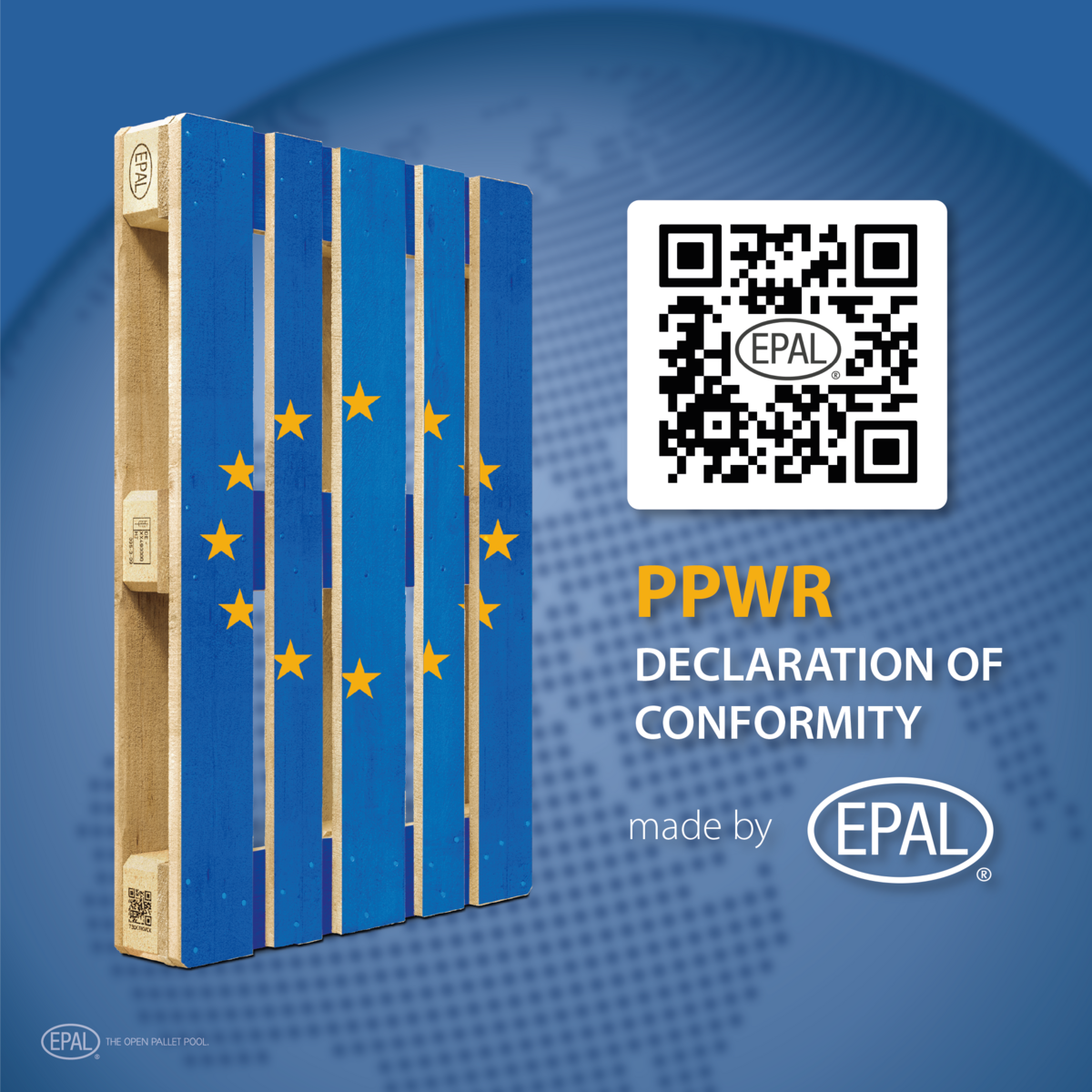
At the same time, users of EPAL pallets and EPAL-licensed suppliers of EPAL pallets also have the option of using a QR code containing information on the PPWR compliance of EPAL pallets. Scanning the QR code displays the digital pallet passport for EPAL pallets. In addition to the PPWR declarations of conformity for EPAL pallets, this also contains further important information about EPAL pallets and the EPAL pallet pool. Users and licensed suppliers of EPAL pallets can include the QR code in their delivery documents or forward it as a file, thereby providing evidence of PPWR compliance to the recipient of the EPAL pallets.
Jarek Maciążek, President of EPAL:
“To facilitate proof of PPWR compliance, we use the digital pallet passport for EPAL pallets, which we developed when EPAL pallets with QR codes were introduced in Year 2024 and which originally contained only information about the production of EPAL pallets. We have now further developed the digital pallet passport and will, in future, make all key information about EPAL pallets and their use and reuse available here, such as the PPWR declarations of conformity for EPAL pallets. The QR code and the digital pallet passport for EPAL pallets, together with the marking of EPAL pallets, also serve to fulfil the marking requirement in accordance with Article 15(6) of the PPWR.”
The requirements for PPWR declarations of conformity are set out in Annex VIII of the PPWR. The PPWR declarations of conformity for EPAL pallets are based on these requirements. Among other things, they provide confirmation that EPAL pallets are recyclable and reusable and that they meet the requirements for substances in packaging as set out in Article 5 of the PPWR.
EPAL has carried out the conformity assessment procedure and documented the result in the PPWR declarations of conformity for EPAL pallets. In doing so, EPAL has been able to draw on the extensive data collected over many years as part of EPAL’s independent quality assurance programme. EPAL’s quality assurance programme will continue to guarantee the PPWR conformity of EPAL pallets in the future.
Bernd Dörre, Chief Executive Officer of EPAL:
“The preparation of PPWR declarations of conformity is not a one-off process. Packaging manufacturers are obliged to continuously verify and ensure the PPWR compliance of their packaging and to document this. This also applies to EPAL pallets. To fulfil these obligations, EPAL can draw on its quality assurance system for EPAL pallets, which has been in place for decades. This not only guarantees the high quality and safety of EPAL pallets, but also their reusability. This is a key aspect of the PPWR compliance of EPAL pallets and is equally crucial to the success of the open EPAL pallet pool.”
On 3 August 2026, the European Commission published the second version of the FAQs providing an explanation of the PPWR. In these FAQs, the EPAL pallet pool is once again cited as an example of an open reuse system in accordance with the provisions of the PPWR. By using EPAL pallets, which form part of the EPAL pallet pool reuse system, users of EPAL pallets can support to achieve the reuse targets that will apply to them from Year 2030 onwards. As an open pallet pool, EPAL thus offers free access to PPWR-compliant and reusable EPAL pallets and provides confirmation of this with the PPWR declarations of conformity for EPAL pallets.
Companies that transport or store goods on pallets can ensure that the pallets they use comply with the PPWR by using EPAL pallets, without any contractual obligations and at no additional cost. EPAL will therefore integrate further pallet types into the EPAL pallet pool in future to make it easier for industry, retail and logistics to meet the requirements of the PPWR.
Dirk Hoferer, President of EPAL:
“The reuse of packaging works particularly well when it is easily accessible and the pallets can be shared by as many companies as possible across different sectors. This is the strength of the open EPAL pallet pool, and the publication of the PPWR declarations of conformity for EPAL pallets contributes to this. The successful development of EPAL CP pallet production in Year 2026 also stems from the need to demonstrate PPWR compliance for CP pallets Therefore, the PPWR declarations of conformity are of course also available for all nine types of EPAL CP pallets."
About EPAL:
The European Pallet Association e.V. (EPAL), founded in 1991, is an international non-profit association and organises the open EPAL pallet pool. More than 1,750 EPAL licensees produce and repair EPAL Euro pallets and other EPAL load carriers. Currently, there are more than 670 million EPAL Euro pallets and around 20 million EPAL box pallets in circulation, making the EPAL pallet pool the world’s largest open pallet exchange pool.
With its principles of re-use, exchange, repair and recycling of pallets, the open EPAL pallet pool has been a prime example of a sustainable circular economy for more than three decades. EPAL wooden Euro pallets make a significant contribution to climate protection. They store CO2 , prevent waste, reduce the demand for timber and thus improve the CO2 footprint of users in industry, retail and logistics.
Further information for journalists:
European Pallet Association e.V. (EPAL)
Fabian Preuss (Communication Manager)
T +49 (0) 211 98 480 48 55
M +49 (0) 0152 55 33 62 88
fabian.preuss@epal-pallets.org